From the President's Desk: Lessons from a 1.2 million-pound 1940s locomotive
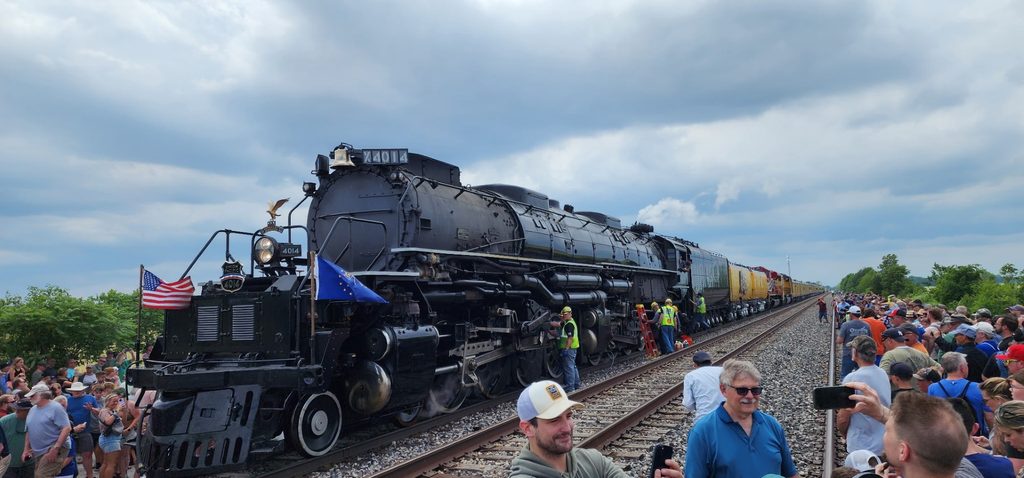
An enormous historical monument is currently rolling across our country: Union Pacific is moving the only operating 4014 steam engine (nicknamed “Big Boy”) from out west all the way to Philadelphia for the 250th celebration of the founding of the United States!
This black steel behemoth, the largest steam engine ever built, is one of the very few steam-powered machines still operating at full capacity today. After diesel engines replaced resource-intensive boilers, these steam-chuffing beasts, which once devoured coal in a blazing firebox, began to show up sparsely after the 1950s.
Eight 4014s were built, entering service around 1941 – a date that carries significant historical weight for U.S. manufacturing, though that’s a story for another time – and were specifically built to haul extremely heavy freight. These 133-feet long 4-8-8-4 giants (that’s right, they were built with sixteen drive wheels – and each engine and tender weighs a casual 1,200,000 pounds) would yank trains over terrain that no other locomotive could tackle. “Big Boy,” in particular, was used to haul heavy freight trains across the Rocky Mountains, pulling loads of up to 7.6 million pounds across the high desert of Wyoming and other parts of the West.
But with the advent of diesel-electric engines, Big Boy was retired in 1961. Visionaries at Union Pacific saw its value, and in 2019 (the 150th anniversary of the Transcontinental Railroad’s completion) they restored this majestic dragon to life, including converting it from coal-burning to No. 5 fuel oil, making the trip much more practical. Its route to Philadelphia took it only two hours north of my house – surely, this was worth the drive.
My gracious wife volunteered to accompany me on this trek – and didn’t even make fun of my train shirt! We prepped to arrive in Argos, Indiana, a town so small it barely registers on most maps, two hours early to see Big Boy as it passed through and stopped for servicing.
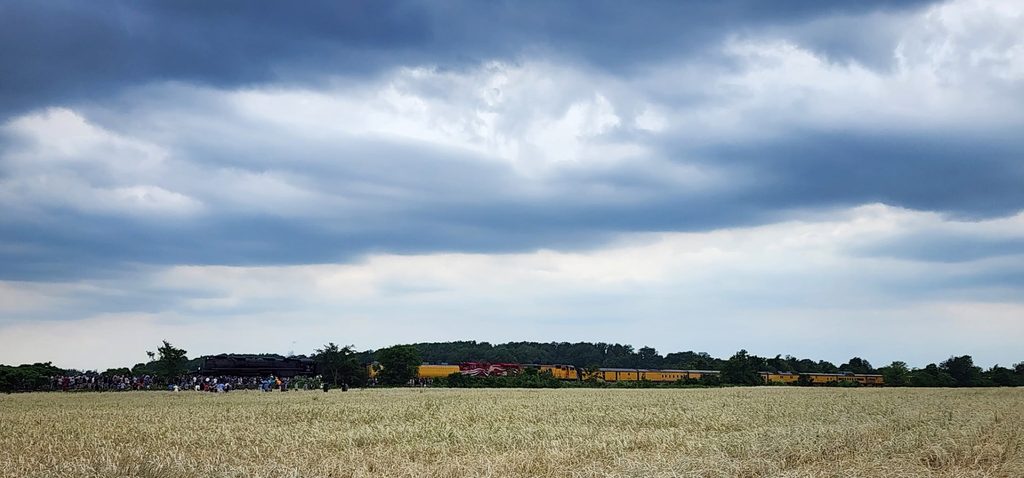
As we drove into town, each car in front of us seemed to be following our intended route. It turns out we weren’t the only ones there that day to see a piece of American history. The crossing site was changed at the last minute to be several miles outside Argos. Even though we were already on a narrow, hardly-paved road in between fields in northern Indiana, as we got closer to the proposed stopping point, cars started pulling over in roadside ditches to park. Their occupants opened their doors into tall wheat so they could start the trek to the viewing site. Folks had coolers, camp chairs, and specialized radio antennas built into their cars.
In our car, we crawled through the chaos. Finally, my wife found a side road even further off the map. As a result, most people hadn’t realized it was there. It was a quick 15-minute walk to the crossing!
As we stood with the throng of people on the rough limestone of the railbed, a mound of old rock amid a vastness of fields, at a meaningless road crossing in the absolute center of nowhere, we stared westward, hoping to spot a light or puff of steam indicating the train was near. You could feel the crowd’s excitement building. We met sheet metal workers, factory employees, retired veterans, enthusiastic train nerds, energetic kids, and longtime rail workers. Each of us was there for the same reason.
We finally saw a light on the horizon, and it was coming our way. We watched as it slowly, slowly drew closer (a train that size can take more than one mile to brake to a stop). When it finally paused, it exhaled like the living dragon it was. The massive drive wheels and black steel glinted, and although stopped, the train’s two boilers and power systems did not take a break. The machine vented steam, chugging and chuffing at irregular intervals, and bled water out the sides. Mechanics swarmed the beast in order to try to meet its needs and keep it running until its next stop. The sheer size of the train was unbelievable.
Rain threatened, and we wanted to get a head start on the crowd, so we started the walk back towards our car. From a distance, walking parallel to the track, you could see the “AMERICA 250” paint jobs the trailing cars had been given for the occasion. The train continued to hoot and whistle as we drove away. It struck me that this was the perfect chance to reflect on what we could learn from this massive machine!
First, we should never forget that we’re here because others put their blood, sweat, and tears into building what’s around us. At Connico, we honor that legacy every day.Connie sacrificed so much to build our “rail network” – tracks we still travel today. So is there someone in your life who helped get you where you are today, and how can you show them your appreciation? (not necessarily like the victory lap Big Boy is receiving, but a grand gesture nonetheless!)
Second, just because we are different does not mean we can’t share the same goal and pour appreciation into the same thing. We met many different folks on our journey, and we certainly stood out (I’m a suburban guy, and you will notice me out of place standing in a cornfield). But we were all there to experience this huge milestone for our nation. We came from different places and had different jobs and different beliefs, but we had a grand old time together watching this train! It reminded me of when Connico developed our core values: we got every single person in one room around one massive clump of tables to construct a solid railbed for our future plans. Are there places where you could put differences aside in celebration of something awesome?
Lastly, standing in the shadow of this mountain of black metal made me realize that collaboration is everything. Teamwork is a uniquely human trait, by and large, and it’s our ability to cooperate on massive scales that allows us to build pyramids, go to the moon, raise families, develop technology, and work to better our society. This is what work is really all about. Together, humans can do extraordinary things, and it shows up in powerful ways. Where is cooperation helping you blaze new trails?
On the way out of town, we stopped at a local Amish deli. Over sandwiches, in a corner of the log-cabin-style grocery and kitchen, we listened to the crowd around us: a 7-year Army veteran who was now retired, an Air Force veteran and an archaeological specialist who both volunteer at Indiana’s Grissom Air Museum, and a family who’d spent the day in another small, off-the-map town in Indiana. I was out of my league, but we were welcomed into the conversation nonetheless to swap train facts and chat about life. And just a few miles away, Big Boy, the last 4014, rumbled back to full steam, pulling behind it a dozen Union Pacific cars … and the weight of the American Dream.
Most land-based machines heavier than Big Boy are built to move or reshape the earth’s surface, including tunnel boring machines like this one and other mining or drilling equipment.
A special thanks to my friend Rick Popp with GE for first telling me about Big Boy’s journey and making sure I didn't miss the chance to see it in person!