Word on the Runway: What separates successful airport projects?
Airport projects are where planning meets real-world pressure. As a leading construction consultant supporting aviation projects nationwide, Connico knows the best insights often come from the people closest to the work. For this edition of Word on the Runway, we brought together peers across the aviation industry to compare perspectives on what determines outcomes on the airfield.
In the latest installment of Connico’s Word on the Runway series, we asked:
What separates a successful airport project from one that struggles?
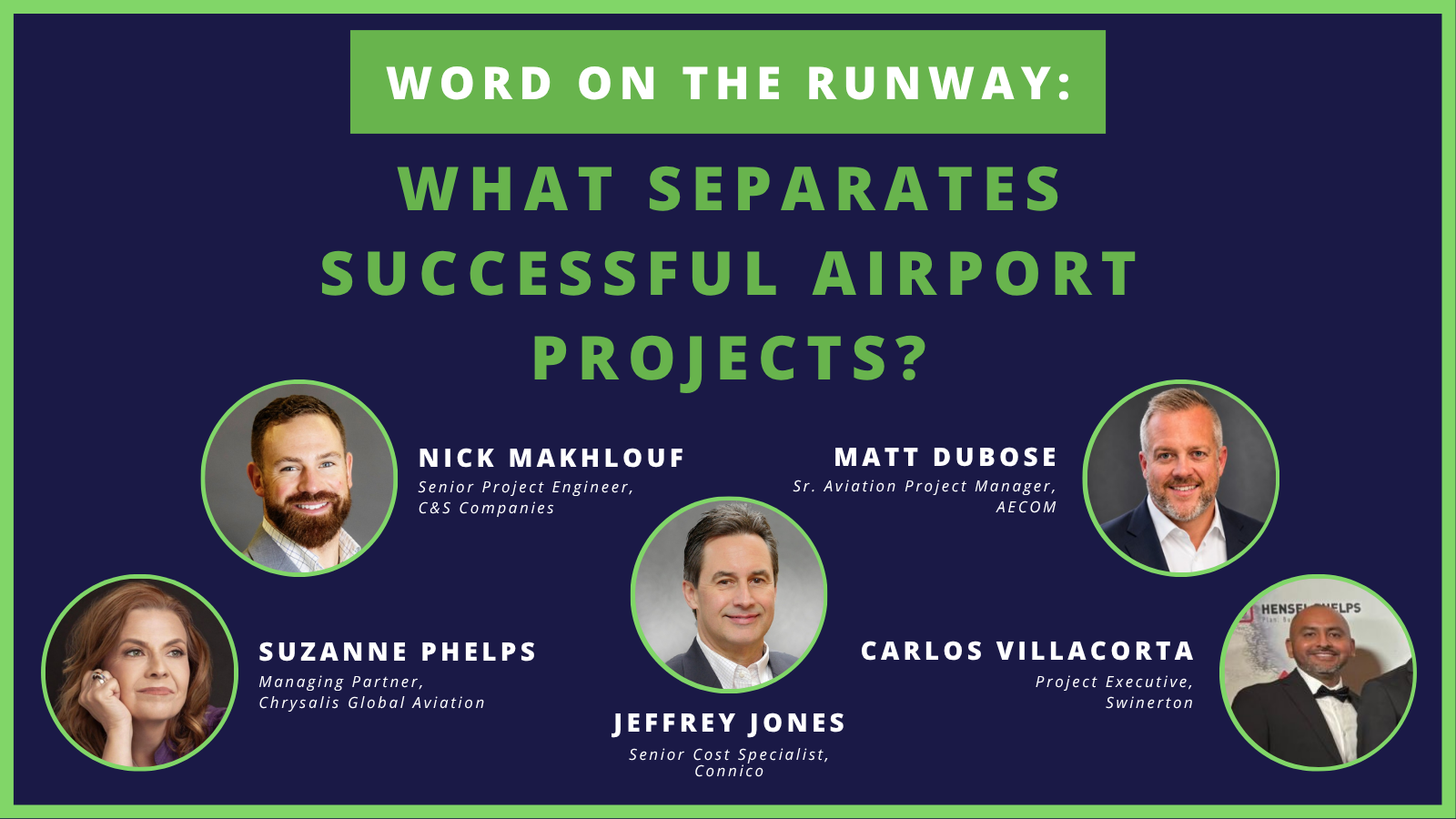
Jeffrey Jones, Senior Cost Specialist: Stakeholder alignment
Alignment among key stakeholders during the pre-design phase is critical to a project’s ultimate success. That includes the airport authority, airline representatives, the FAA, TSA, and an integrated design team with clearly defined responsibilities. Because most airports cannot close for any substantial length of time, operational continuity is another difficult factor that must be addressed early in planning. Gaps discovered during construction are far more costly to resolve than those identified upfront. The decisions made before design begins often set the tone for the project’s success.
Another key consideration is establishing realistic cost and schedule parameters that account for escalation on long-duration projects and extended lead times for major mechanical, electrical, and plumbing equipment. We have seen lead times of 45-50 weeks for chillers and electrical switchgear, which can delay final system commissioning and turnover. The construction phasing plan must also be coordinated with the airport’s operational calendar to minimize major disruptions as the project progresses.
Nick Makhlouf, Senior Project Engineer at C&S Companies: Planning and training
Adequate planning and having the right people in the room during that planning. There is often pressure to get projects off the ground and deliver them quickly, and that is the expectation. Sometimes, we move too quickly, and do not always have the right people in the room to offer their input.
That is especially true when working with teammates or others in the industry you may be less familiar with. Without those perspectives, you can miss information, scoping items, or questions you should be asking the client because they may not be on your radar. When that happens, teams can get halfway through a project before realizing they needed additional information, a different area of expertise, or a clearer understanding of the full scope from the beginning.
I also think adequate training of younger staff is important – training-up the next set of “right people” in the room. That means being transparent with younger staff about your thought process and what you are doing day to day to get projects moving, keep projects on track, manage clients effectively, and communicate clearly. Transparency matters, but so does explaining why you made a decision or what you were thinking about. They can see your actions and the direction you give, but they cannot see the process behind it unless you explain it. In the long run, that translates to successful projects because younger team members are able to understand all the small components that go into decision-making and communication.
Suzanne Phelps, Managing Partner at Chrysalis Global Aviation: Operational readiness
Airports have been delivering construction projects for a long time, and they have the fundamentals down. They know how to hire architects, engineers, construction managers, and other project partners. Those elements are well understood and well honed. What we have found, though, is that the main difference between a successful airport project and one that is less successful is the focus on operational readiness.
There is often an intense focus on whether a facility is technically complete: Is construction done? Are the systems installed? There is not always the same focus on whether the facility is operationally capable. Are people able to navigate the new environment? Do they know how to use the new systems? Can passengers understand the wayfinding signage? The discipline that undergirds this work is called ORAT, which stands for operational readiness, activation, and transition. Broadly speaking, it ensures all people, processes, tools, and technologies are aligned and prepared for operating in the new environment.
Matt DuBose, Senior Aviation Project Manager at AECOM: Communication
Communication is the biggest part, whether you’re talking with your team or other teams involved in the project.
For example, the Fourth Parallel Runway project at Charlotte Douglas International Airport (CLT) included four designers and seven bid packages. Through that process, we really became like a family with the program manager and the other designers. Everybody had the same mission. We knew where we were headed, and we were all pulling the rope in the same direction. It was a challenging project, but it was also a fun project because of that shared commitment. It comes back to communication and being proactive in how you handle the project.
Carlos Villacorta, Project Executive at Swinerton: Leadership alignment
Successful airport projects come down to alignment, especially between leadership and the broader project team. When leadership is aligned with the team and willing to lead from behind, titles get put aside and the work becomes a true team effort.
When everyone is aligned on the strategy from the beginning, the project moves more smoothly. That is when you know the culture is working. Projects can be stressful and demanding, but when the team keeps emotions even-keeled and stays focused on the goal, it becomes much easier to see the project through.
As experts in consulting services and problem-solving, Connico is focused on innovative solutions for clients and the world. Our skilled team specializes in cost estimating, program management, scheduling/phasing, construction administration, project management, and constructability planning services. Our work is transforming projects across commercial aviation, federal government, energy, and beyond.
Have a question for our Word on the Runway series or want to connect with our team? Get in touch.