
What early-career professionals are teaching us about aviation’s future
In an industry evolving as quickly as aviation, staying ahead demands fresh perspective. Industry conferences create space for young professionals to step back and understand where they fit within that change, and for several Connico team members, this year’s AAAE/ACC Planning, Design, and Construction Symposium offered exactly that.
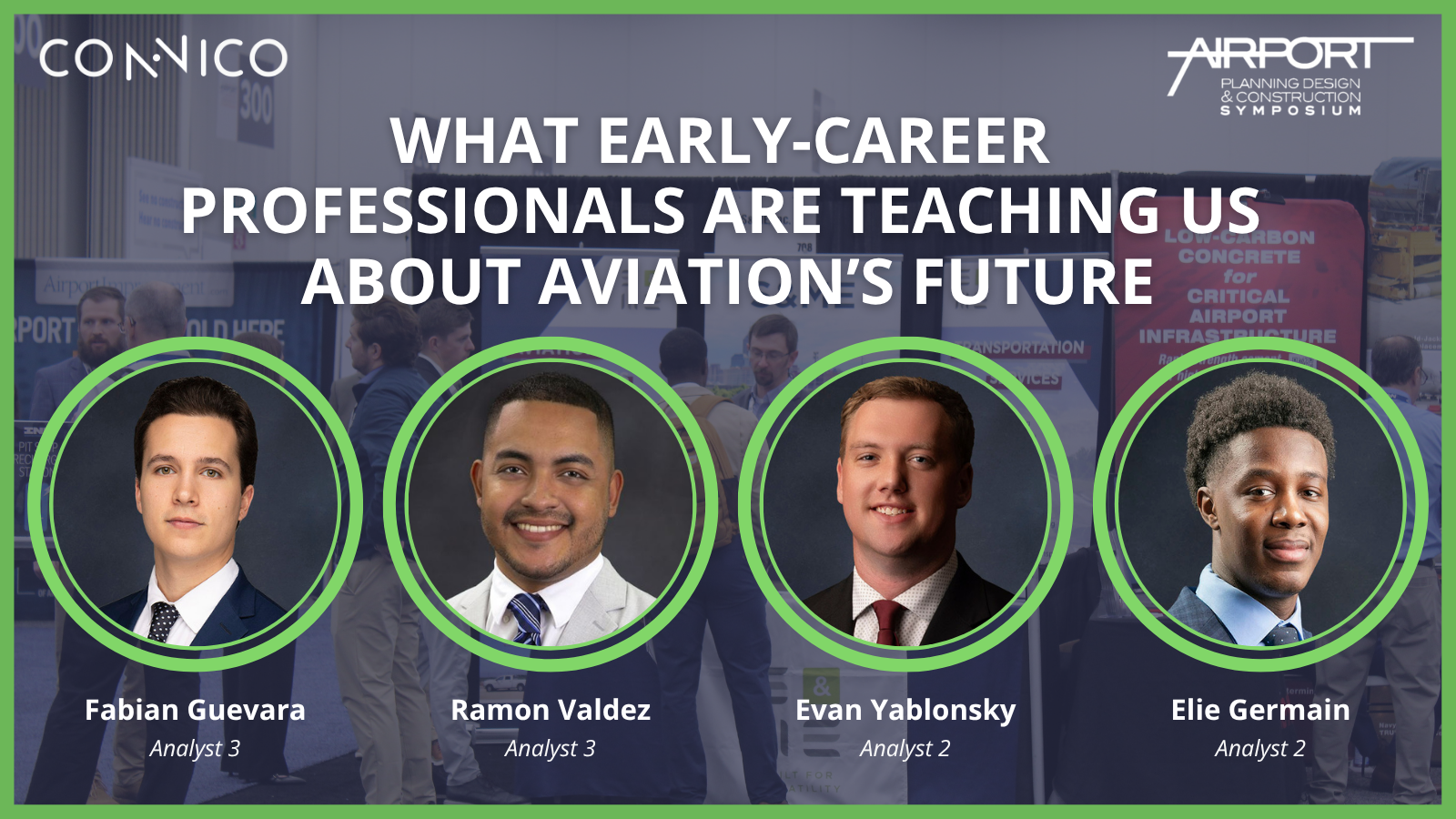
Elie Germain, Evan Yablonsky, Fabian Guevara, and Ramon Valdez represented Connico. Through conversations with peers, clients, and industry leaders, they gained insight into career growth and the role of emerging technologies in aviation. They brought those learnings back to Connico to improve how we work and serve clients. Here’s a look at how they're thinking differently about aviation’s future.
How did the Symposium influence how you think about your own career path?
The Symposium reinforced how much opportunity I have to grow within the aviation sector. I have the flexibility to explore a variety of paths in estimating, scheduling, leadership, or beyond, especially at a firm like Connico. Attending sessions and connecting with other firms gave me a new appreciation for the breadth of experience I have exposure to at a smaller company. We work on a wide range of projects with firms nationwide. Seeing the impact we have across cities and states is incredibly motivating for me.
One moment that stood out was speaking with clients who already recognized my name simply from being copied on emails. This served as a quiet reminder that my contributions carry more weight than I realize, and it pushed me to approach my role with greater confidence.
Elie Germain, Analyst 2
What insights challenged or expanded your perspective?
One of the biggest themes throughout the conference was the industry’s evolving relationship with AI, particularly concerns about overreliance and reliability. In one session, a study was shared about how different work structures utilized AI and their outcomes. In the study, participants were divided into three groups: one worked independently, one relied solely on AI, and the third combined their own critical thinking with AI support. The group that blended both approaches produced the strongest results.
This study reinforced that AI should be treated as a tool, but not a replacement. It has the potential to enhance the quality of our work and improve efficiency, but it still requires human insight and judgment to be effective.
I also noticed a generational divide in how AI is perceived. Many senior professionals expressed concern about younger professionals relying too heavily on it. I think there’s a shared responsibility. Senior professionals should continue encouraging critical thinking, while younger professionals can help drive the integration of new technologies into daily workflows.
AI isn’t something on the horizon. It’s already here, and it will only continue to evolve no matter how much we resist. Attending the Symposium helped me see that our industry’s success depends on finding the right balance between adopting new technologies and staying grounded in strong, thoughtful decision-making.
Fabian Guevara, Analyst 3
What kind of impact do you hope to make as you continue to grow in this industry?
As I continue to grow in this industry, I hope to play a meaningful role in helping clients navigate large, complex projects across all the projects I touch. New terminal developments or major roadway improvements at airports go beyond infrastructure to shape how people travel, connect, and experience their communities.
My goal is to deliver accurate, reliable estimates early in the process that set projects up for success and remain dependable as they move through design and construction. By helping establish a clear financial foundation from the start, I can support better decision-making and more efficient project delivery.
Ultimately, I want to be a trusted partner who brings clarity and confidence to major investments, ensuring that the projects we deliver meet client goals and create a lasting impact for the communities they serve.
Ramon Valdez, Analyst 3
What skills are you intentionally working to develop at this stage in your career?
At this stage in my career, I’m focused on taking initiative and staying open to new challenges, especially when it comes to complex projects. I’m intentionally building a diverse skill set and strengthening my technical abilities to contribute across a wide range of tasks.
My ultimate goal is to become a go-to team member that my team can depend on when a project needs support. Across the sessions, senior professionals reinforced that success comes from being someone others trust.
Elie Germain, Analyst 2
I’m focused on absorbing as much as I can about the aviation and engineering industry. That means looking beyond just design work and gaining a deeper understanding of construction management, risk allocation, and team leadership.
I’m dedicated to developing a well-rounded skill set that allows me to add value in any situation, whether that’s on a project team or within the broader industry. The goal is to become indispensable, not just within my company, but as a professional who can step in, adapt, and contribute wherever needed.
Evan Yablonsky, Analyst 2
What trends do you see shaping the future of airport planning, design, and construction?
The pace of technological change. Advances in AI, automation, and emerging technologies are happening faster than traditional planning and design timelines can keep up with. In many cases, projects are planned years, and sometimes decades, in advance. By the time they’re implemented, certain assumptions may be outdated.
For example, we may currently be designing large airport parking structures based on today’s demand, but with the rise of autonomous vehicles, that demand could shift significantly in the future. This creates a need for more adaptable, forward-thinking design strategies. As an industry, we’ll need to find ways to balance long-term planning with the flexibility to evolve alongside rapidly changing technology.
Fabian Guevara, Analyst 3
Building the future of the industry
These perspectives highlight the value of early-career exposure to industry conversations and the importance of continuous learning in a field that is constantly evolving. Early-career professionals are learning today, and they are the leaders of tomorrow.
Investing in the next generation of aviation means creating opportunities like this to attend conferences, engage with industry leaders, and bring new ideas back to their work. Connico is committed to being the best place to work through fostering a culture of curiosity, collaboration, and growth. We aim to equip young professionals with the experiences and support to build meaningful, lasting careers.
Interested in reading more about Connico’s Symposium experience? Read Business Development Specialist Andrew Skidmore’s takeaways here.