
Word on the Runway: What’s poised to take off in 2026?
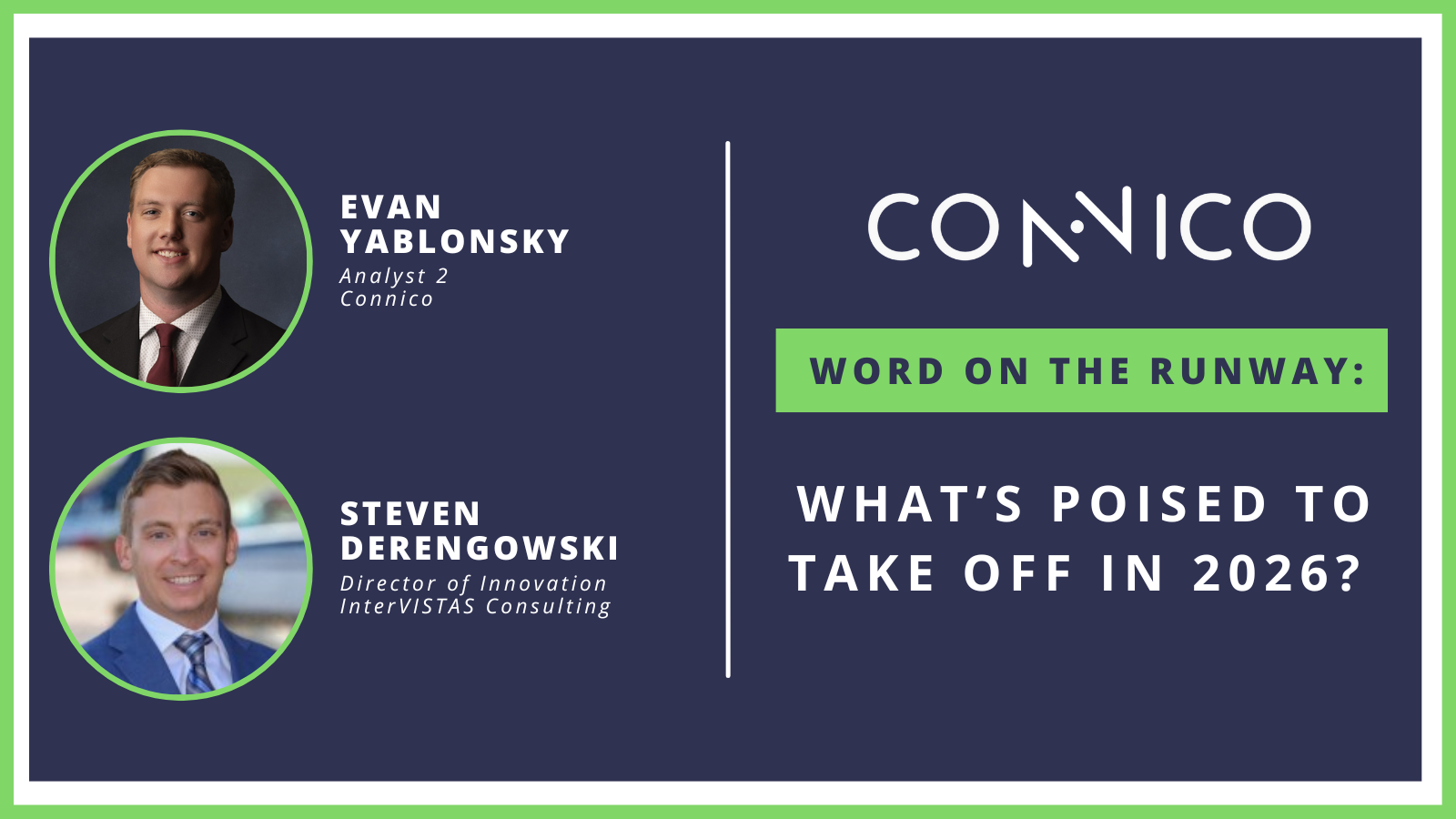
Aviation has spent the last few years balancing record investment with real-world constraints. Building windows are becoming tighter, there are more stakeholders to coordinate, and expectations for safety, uptime, and accountability are higher than ever. As we head into 2026, two themes are rising to the top – preparing for what’s next in air mobility and getting sharper about risk as airport programs scale.
In the latest installment of Connico’s Word on the Runway series, we asked:
What shift, challenge or emerging opportunity do you believe will be the most important for aviation in 2026, and how are you thinking about it in your own work as you plan for the year ahead?
Steven Derengowski
Director of Innovation, InterVISTAS Consulting
When I look ahead to 2026, one of the most important opportunities that may present itself in a new way is Advanced Air Mobility (AAM). It has been a hot topic in our industry for several years, but 2026 feels different. We are expecting to see meaningful policy and certification milestones from the FAA that move AAM beyond concepts and pilot programs and much closer to being market ready.
What excites me most is that the opportunity is not limited to the operational mission itself, whether that is moving people, cargo, or supporting regional connectivity. The bigger opportunity is in building the broader ecosystem around the technology. That includes not only facilities to handle the operation, but also flight training, manufacturing, testing, and continued aircraft development as platforms mature and scale.
From an airport and planning perspective, this shift opens the door to thinking differently about land use, infrastructure, and long-term investment strategies. When you pair advancing technology with clearer regulatory pathways, AAM becomes less of a future vision and more of a practical planning consideration. For airports in particular, this creates a chance to diversify revenue, attract new types of tenants, and position themselves early in an emerging sector. That combination of policy progress and ecosystem development is what makes 2026 such an interesting year for AAM.
Evan Yablonsky
Analyst 2, Connico
Risk management will be a critical piece of aviation project management in the coming year. The demand for aviation construction is projected to grow 2% annually through 2034, meaning that more projects will be completed at the same major airports. This increase in construction demand presents an unprecedented amount of risk to airport operations and logistics, overall safety, procurement and funding, and project cost and schedule.
At Connico, we provide value and manage risk by understanding the project as a whole, analyzing the big picture and the minute details. Projects are becoming more complex and are introducing more unknowns. Our scheduling team assists with complex phasing, incorporates risk possibilities, and runs simulations to develop realistic schedules, while our estimating team looks beyond the drawings to forecast true project costs and risk.
Recent developments in technology, artificial intelligence, and automation can be implemented to mitigate increased risk levels in aviation programs. Project managers can utilize AI and automation systems to parse existing data points and come up with preferred alternatives for project designs, automate tedious paperwork, and make data-driven decisions.
As experts in consulting services and problem-solving, Connico is focused on innovative solutions for clients and the world. Our skilled team specializes in cost estimating, program management, scheduling/phasing, construction administration, project management, and constructability planning services. Our work is transforming projects across commercial aviation, federal government, energy, and beyond.
Have a question for our Word on the Runway series or want to connect with our team? Get in touch.